Linear Circuit Analysis
1. Introduction
2. Basic Concepts
- Charge, current, and voltage
- Power and energy
- Linear circuits
- Linear components
- Nodes and loops
- Series and parallel
- R, L & C combinations
- V & I combinations
3. Simple Circuits
- Ohm's law
- Kirchhoff's current law
- Kirchhoff's voltage law
- Single loop circuits
- Single node-pair circuits
- Voltage division
- Current division
4. Nodal and Mesh Analysis (DC)
5. Additional Analysis Techniques (DC)
- Superposition
- Source transformation
- The $V_{test}/I_{test}$ method
- Norton equivalent
- Thévenin equivalent
- Max power transfer
- DC analysis of L & C
6. AC Analysis
7. Magnetically Coupled Circuits
8. Polyphase Systems
9. Operational Amplifiers
10. Laplace Transforms
11. Time-Dependent Circuits
- Introduction
- Inductors and capacitors
- First-order transients
- Second-order transients
-
Parallel RLC circuits
Series RLC circuits - Nodal analysis
- Mesh analysis
- Laplace transforms
- Additional techniques
12. Two-Port Networks
Appendix
Ohm's Law
Ohm’s law states that the voltage across a resistor is directly proportional to the current going through the resistor. Denoting the constant of proportionality with $R$ (the resistance), one can express Ohm's law mathematically as $$\begin{equation}V=RI\end{equation}$$ or $$\begin{equation}I=\frac{V}{R}\end{equation}$$ where voltage $V$ and current $I$ are shown in Fig. 1. It is important to note that the value of the current calculated using Ohm’s law depends on how the voltage $V$ is defined. As shown in the figure, the current is assumed to flow from the $+$ node to the $–$ node; depending on the sign of $V$, this current can be either positive or negative.
If we introduce the conductance as the reciprocal of the resistance $G=\frac{1}{R}$, Ohm's law becomes $V=\frac{I}{G}$ or $I=GV$. (Please do not confuse conductance $G$ with gain $G$, which is a quantity that will be defined later in this webbook.)
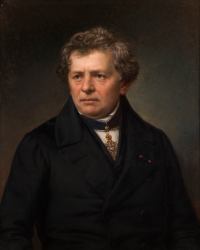
The SI unit of resistance is ohm (${\class{mjunit}{Ω}}$). The name comes from the German physicist Georg Ohm (1789–1854), who formulated Ohm’s law, establishing the fundamental relationship between voltage, current, and resistance in an electrical circuit. The unit for conductance is siemens (${\class{mjunit}{S}}={\class{mjunit}{Ω^{-1}}}$), also known as mho (${\class{mjunit}{℧}}$).
Examples of Solved Problems
-
Ohm's law (analytical)
Circuit with 1 resistor and 1 voltage source (analytical)
Circuit with 1 resistor and 1 current source (analytical)
Circuit with 2 resistors and 1 voltage source (analytical)
Circuit with 2 resistors and 1 current source (analytical)
-
Ohm's law (numerical)
Circuit with 2 resistors and 1 voltage source (analytical)
Circuit with 2 resistors and 1 current source (analytical)
Circuit with 1 resistor and 1 voltage source (numerical)
Circuit with 1 resistor and 1 current source (numerical)
-
Ohm's law (design)
Circuit with 1 resistor and 1 voltage source (numerical design)
Circuit with 1 resistor and 1 current source (numerical design)
Circuit with 2 resistors and 1 voltage source (numerical design)
Circuit with 2 resistors and 1 current source (numerical design)
See also
Kirchhoff's current law (KCL)
Kirchhoff's voltage law (KVL)